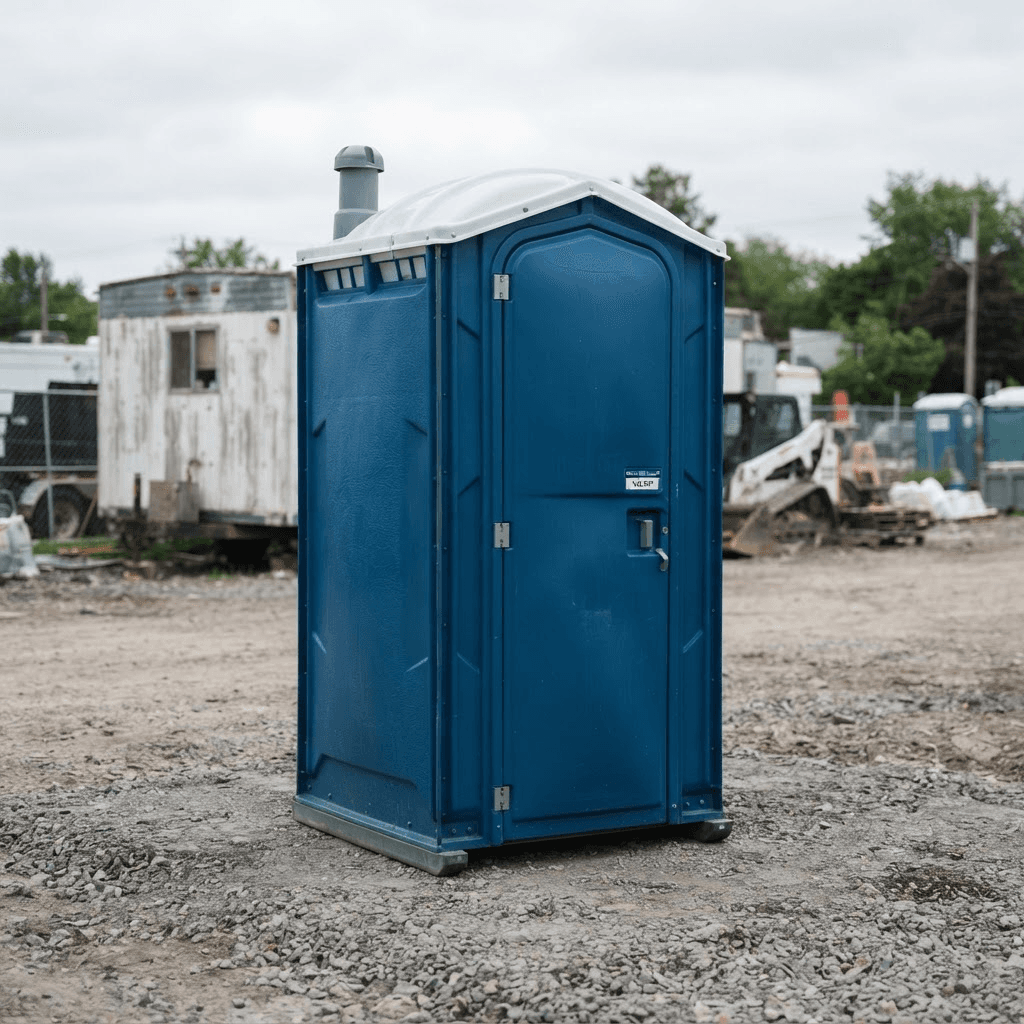
What a standard unit actually is
A standard portable restroom is a molded polyethylene enclosure with a bench-style seat over a sealed waste tank, a urinal on the sidewall of most models, a vent stack that pulls odor up and out, and a translucent roof panel so the interior is usable without any power. It is freestanding. Nothing gets hooked up, nothing gets plumbed, and it can sit on grass, gravel, asphalt or a compacted dirt pad.
This is the unit that covers the large majority of what we deliver around Mentor and the rest of Lake County. It is the cheapest per-person way to provide a restroom, and because the units are identical, scaling capacity is simply a question of how many you place and where.
How many standard units you need
For a construction site, the widely used planning figure is one unit per ten workers on a forty-hour week, with service once a week. Add a unit if the crew runs overtime, if the site is spread out enough that walking to a single unit costs real time, or if trades stack up during a push.
For events, plan around attendance and duration rather than headcount alone. A four-hour gathering of 100 people is usually comfortable with two units; the same 100 people over eight hours with food and drink service is closer to three or four. Alcohol service meaningfully increases usage. These are planning assumptions, not guarantees — tell us the schedule and we will size it with you rather than guessing.
Placement and access
We need to get a delivery truck within a reasonable distance of the placement spot — roughly ten to fifteen feet is ideal, because units are moved by hand from the truck. Level, firm ground matters more than surface type. Soft spring ground in Northeast Ohio can be a real constraint; a sheet of plywood under the unit solves most of it.
Keep units away from doorways, food service and anything downwind of seating. On a windy Lake Erie afternoon, orientation matters: place the door out of the prevailing wind and the unit stays noticeably more pleasant.