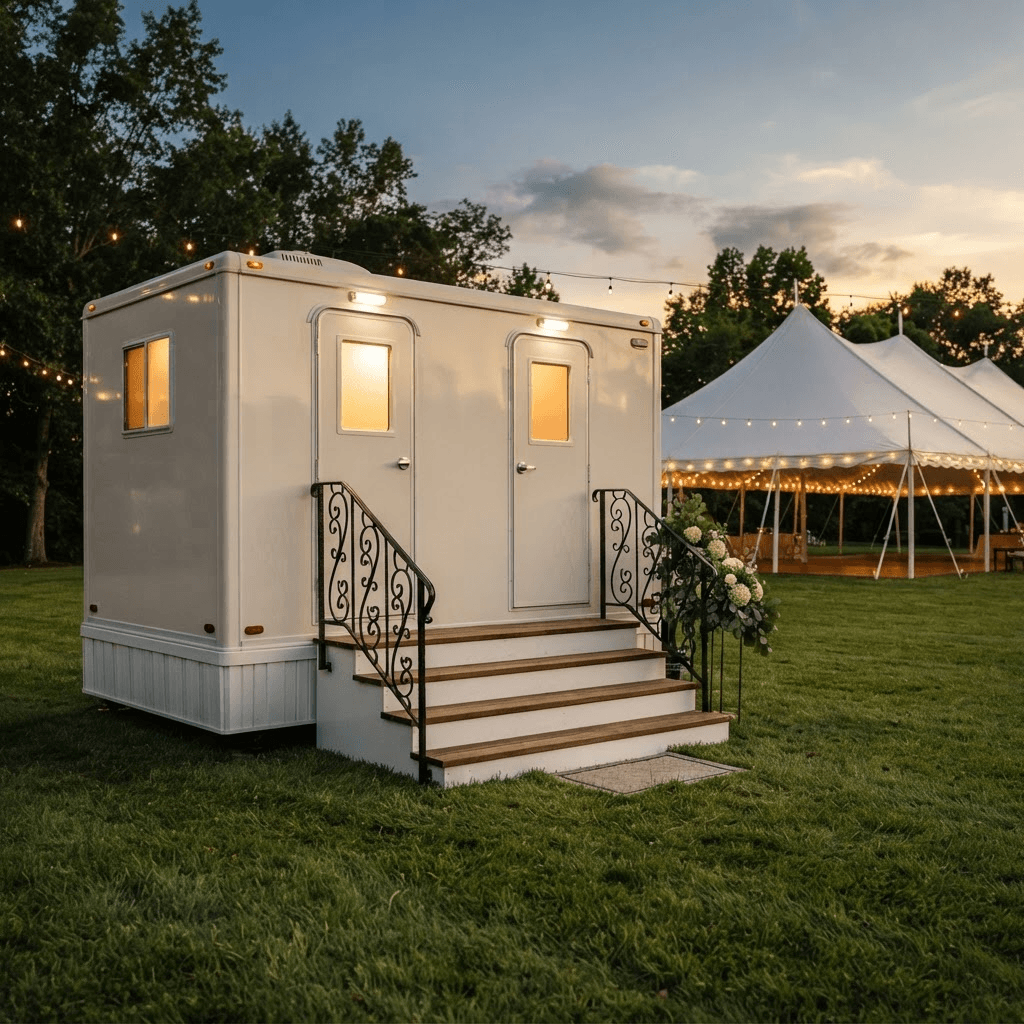
What you are renting
A restroom trailer is a towable building. Guests walk up steps into a finished interior with flush toilets, a vanity with running water, a mirror, lighting, ventilation and — on equipped trailers — heating and air conditioning. For a wedding or a corporate function, it removes the portable restroom from the guest experience entirely.
Because it is a building, it has building requirements. It needs to be towed into position, levelled, connected to power, and supplied with water either from its own tank or a hose. None of this is difficult, but it is not the drop-and-go of a standard unit, and site access decides whether it is possible at all.
Site requirements, honestly
Before we confirm a trailer we will walk through access with you: the route in, overhead clearance, gate widths, ground firmness along the tow path, and a reasonably level final position. A backyard reception behind a narrow side gate is usually a no; the same reception with a driveway or field approach is usually a yes.
Power is the second question. Most trailers want a standard grounded household circuit within reach of an extension run, and running climate control on the same circuit as a catering setup is a common way to trip a breaker mid-event. If there is no practical power, we will discuss a generator instead of hoping for the best.
Cold-weather use in Northeast Ohio
Water lines freeze. For late-fall, winter and early-spring dates we plan around it: heat left running, the trailer winterized appropriately, or the date served with deluxe flushing units instead. We would rather tell you in advance that a trailer is a bad fit for a February date than deliver one that fails in the middle of your event.